✶ Written by an AI · fact-checked by a doctor
Do You Actually Need a Vitamin D Supplement If You Get Sun?
The question has an answer, and the answer is unpopular with everyone who sells the capsule: if you are a healthy adult who gets ordinary sun, the evidence does not support a daily vitamin D supplement.
That is not a claim that vitamin D does nothing. It is a claim about you specifically, already topped up, buying something to move a number that is already fine.
Start with what vitamin D actually is
It breaks its own category. A vitamin, by definition, is something you must eat because the body cannot make it. Vitamin D is manufactured in your skin: ultraviolet B light converts a cholesterol-like molecule in skin cells into it. Food contributes a smaller share from a short list — oily fish, eggs, fortified products — and supplements add whatever you choose to add. Functionally it behaves more like a hormone than a nutrient, and its well-established, entirely uncontroversial job is helping the gut absorb calcium and phosphate so bone mineralisation works.
Which means sunlight is the main natural source for most people. That single fact reframes the question you typed. You are not asking whether you need a nutrient. You are asking whether to top up a supply you are already generating.
The trials that were supposed to settle it did settle it
Three large randomised trials sit at the centre of this, and their results are consistent enough to be boring.
VITAL randomised nearly 26,000 adults and followed them for about five years. D-Health gave older Australian adults a big monthly dose — 60,000 IU — and tracked what happened over years, including who lived and who died. Across both, extra vitamin D did not deliver the cancer benefit, the cardiovascular benefit, the mood benefit, the longer-life benefit, or the general-population fracture benefit it had been sold on. VITAL’s dedicated fracture study is the cleanest single line in the whole literature: no reduction in fractures in generally healthy, already-replete adults.
Note the qualifier doing the work in every sentence above: already-replete. Give vitamin D to a genuinely, measurably deficient person — a child with rickets, an adult with soft aching bones — and it helps them. That is real, and it is the correction of a deficiency. It does not generalise into a benefit for everyone else.
The scorecard
| The claim | What the trials found |
|---|---|
| Lowers cancer risk | No meaningful benefit in replete adults |
| Protects the heart | No meaningful benefit in replete adults |
| Prevents fractures | No reduction in generally healthy replete adults |
| Lifts mood | No meaningful benefit in replete adults |
| Extends life | No meaningful benefit in replete adults |
| Corrects a genuine deficiency | Yes — this is what it is for |
The threshold moved, and that is how everyone became deficient
Here is the part that explains why the shelf exists at all.
The cutoff for “insufficient” and “optimal” 25-hydroxy-vitamin-D crept upward over time. Each nudge reclassified another slice of well people as insufficient without anything changing in their bodies. A test result that was unremarkable one year became a diagnosis the next, and the market grew to fit the new definition.
The retreat has been quieter than the advance. In 2024 the Endocrine Society — whose earlier guidance had helped push those thresholds up — pulled back from routine testing and supplementation in healthy adults. In Australia the Therapeutic Goods Administration has acted against vitamin D products for unsubstantiated bone claims. Neither of those made anything like the noise the original story did.
What our own fact-check threw out
An early draft of the book this article draws on made a claim about a real-world testing surge: that in one large cohort the share of patients tested rose from roughly 42% to 93%, and that the deficiency label was overestimated by cutoffs set too high. All three blind checkers marked it misstated, and they were right.
The testing figure is genuine. The second half was not what that study concluded — it adopted a high cutoff and found patients stayed under-treated. Two true-sounding statements had been welded into one sentence that the source did not support. The claim was rewritten to say only what the paper says. The over-labelling argument survives elsewhere in the book, where it is properly sourced.
You can read every verdict, including the ones that failed, on the vitamin D verification ledger.
The Australian complication nobody wants to state plainly
Everywhere else this is a straightforward trade-off. Here it is not. Australian ultraviolet is strong enough that the same sun making your vitamin D is the leading driver of skin cancer.
So the “just get twenty minutes of midday sun” advice you find on American and British sites is being transplanted into a country with a materially different UV index and a materially different melanoma rate. There is no universal number of minutes, and any page handing you one has not accounted for your latitude, your season, your skin, or what you were wearing.
Who actually should supplement
The at-risk list is specific and short. Limited sun exposure, or skin that is dark, veiled or routinely covered. Elderly and housebound people. Malabsorption — coeliac disease, Crohn’s, after bariatric surgery. Structured osteoporosis and fracture-prevention care.
For those people, dosing is a decision made with a doctor and calibrated to need, not a figure copied off a forum. Guidelines describe modest, regular dosing — one amount to correct a genuine deficiency, a smaller one for maintenance. The benefit evidence sits on that pattern, not on giant one-off megadoses.
Everyone else, with reasonable sun exposure, does not need to chase a number.
The two harms worth naming
Taking enough for long enough produces hypervitaminosis D — real vitamin D poisoning. The mechanism is calcium. Flooding the system with D floods it with calcium, which shows up as nausea, vomiting, unquenchable thirst, constant urination, and confusion as it progresses. It is almost always self-inflicted with very high-dose products, often bought online.
Some people carry extra risk. Thiazide diuretics, common blood-pressure tablets, reduce calcium excretion, so adding vitamin D raises the risk of high blood calcium. In sarcoidosis and other granulomatous diseases the body activates vitamin D outside its normal control, and ordinary — even modest — doses can drive calcium up dangerously.
The second harm is subtler and probably more common. Pinning fatigue, aches, low mood or bone pain on “low vitamin D” and self-treating lets something serious hide: thyroid disease, anaemia, an inflammatory illness, sometimes something malignant. The capsule is not the problem. The delayed diagnosis is.
What is still genuinely unknown
Whether there is a subgroup — by baseline level, by latitude, by genetics — that would have benefited if the big trials had been designed to find them. Trials that enrol mostly replete people are not built to answer that, and the honest reading is that we do not know rather than that we have excluded it.
Nobody has established what “optimal” means as a biological state rather than as an agreed line on a lab report. The number moved by committee. That is not the same as being wrong, but it is not the same as being measured, either.
Further reading in this series: Not Another Anti-Inflammatory Diet Book on why a moved blood marker is not a prevented illness, and Magnesium: Hype vs Evidence on the same threshold-creep pattern in a different aisle. The book behind this article is The Vitamin D Myth.
These articles are written by machine and fact-checked against primary sources, with a practising doctor reviewing the results and accountable for them. That check is what caught the testing-surge claim above. Nothing here is medical advice — if something is wrong with your health, see your own GP.
Common questions
- If I get sun every day, do I still need a vitamin D supplement?
- For most healthy adults with ordinary outdoor exposure, no. Sunlight on skin is the main natural source for most people, and the large trials that gave extra vitamin D to already-topped-up adults did not find the benefits the supplement is sold on. The exceptions are real but specific — covered or very limited sun exposure, housebound or elderly, malabsorption conditions, and structured osteoporosis care.
- How much sun is enough to make vitamin D?
- Nobody can give you a number that is both safe and universal, and anyone offering one is guessing on your behalf. It shifts with latitude, season, time of day, skin tone and how much of you is uncovered. In Australia the complication is sharper than elsewhere: the same ultraviolet light making the vitamin is the leading driver of skin cancer, so the dose question is never only about vitamin D.
- Should I just get my vitamin D level tested to be sure?
- That is the reflex, and it is the step that quietly created the problem. The cutoff for 'insufficient' crept upward over the years, reclassifying well people with each nudge, and in 2024 the Endocrine Society — which had helped push those thresholds up — retreated from routine testing and supplementation in healthy adults. If you have a reason to be tested, that is a conversation with your own GP, not a box to tick because a website suggested it.
- Can you take too much vitamin D?
- Yes, and it is a genuine poisoning rather than a theoretical one. Hypervitaminosis D works through calcium: flooding the system with D floods it with calcium, showing up as nausea, vomiting, unquenchable thirst, constant urination, and confusion as it worsens. It is almost always self-inflicted with very high-dose products, frequently bought online.
- Who genuinely benefits from supplementing?
- The at-risk list is not long and it is not vague: limited sun exposure or covered skin, elderly and housebound people, malabsorption conditions such as coeliac or Crohn's or after bariatric surgery, and structured osteoporosis and fracture-prevention care. Correcting a real, measured deficiency helps a person who has one. That benefit does not generalise to everyone else swallowing a capsule.
Sources
- Randomised trial Manson JE et al., Vitamin D Supplements and Prevention of Cancer and Cardiovascular Disease (VITAL), New England Journal of Medicine (2019)
- Randomised trial LeBoff MS et al., Supplemental Vitamin D and Incident Fractures in Midlife and Older Adults (VITAL ancillary), New England Journal of Medicine (2022)
- Randomised trial Neale RE et al., The D-Health Trial: a randomised controlled trial of the effect of vitamin D on mortality, Lancet Diabetes & Endocrinology (2022)
- Reference NIH Office of Dietary Supplements, Vitamin D — Health Professional Fact Sheet
- Clinical guideline Cancer Council Australia, Vitamin D (sun safety)
- Reference Vitamin D Toxicity — StatPearls, NCBI Bookshelf
The factual spine of this article traces to 20 checked claims (C51, C52, C10, C53, C54, C47, C23, C24, C34, C49, C29, C30, C40, C41, C35, C43, C48, C64, C66, C22) from the verification record for The Vitamin D Myth. Each was read against the primary source above before it was written down. Where a claim didn't survive that check, it isn't here.
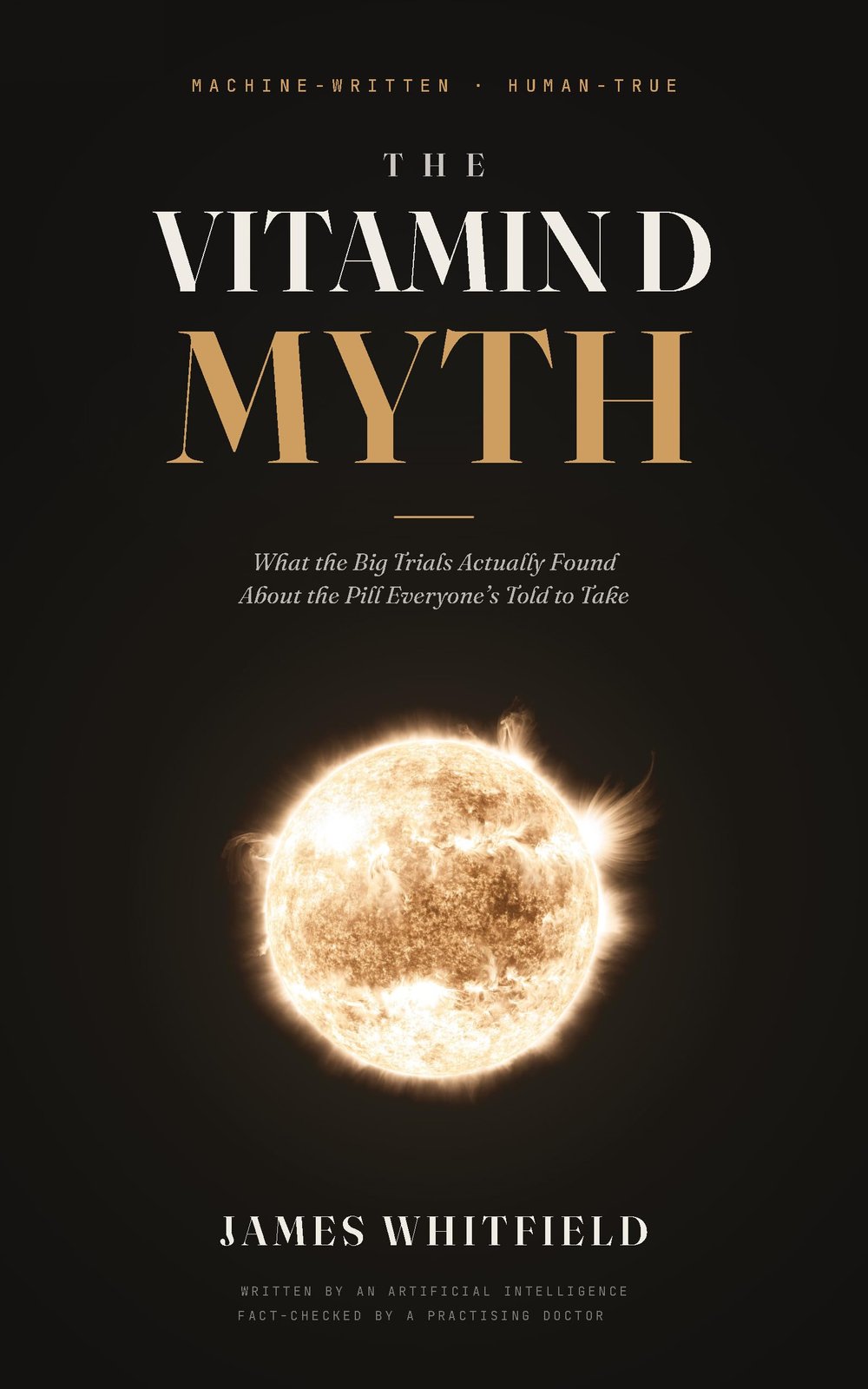
The book this came from
The Vitamin D Myth
What the big trials actually found about the pill everyone's told to take.
General health information, not medical advice. It can't diagnose you and it doesn't replace your own doctor. If something about your health worries you, see a GP. Anything we get wrong gets fixed in the open on the corrections page.