✶ Written by an AI · fact-checked by a doctor
Does Colostrum Survive Your Stomach?
Every colostrum brand tells the same origin story. A newborn calf drinks its mother’s first milk, absorbs her antibodies, and inherits her immune defences. Then the pitch arrives: you can do that too, from a tub.
The story is accurate. The transfer is real, it is called passive immunity, and it is the reason colostrum exists in mammalian biology at all. The question this article exists to answer is much narrower, and it is the one the category rests on: when you swallow the powder, what actually gets through?
Two questions that keep getting merged
“Does colostrum survive stomach acid” is doing double duty, and separating the two meanings resolves most of the confusion.
The first meaning: do the immunoglobulins survive digestion intact enough to still be immunoglobulins by the time they reach the intestine? The second: do those immunoglobulins then cross the gut wall into your bloodstream, the way the calf’s do?
The answers are different. The first is a qualified yes. The second is no.
Marketing copy runs the two together, because the first answer is true and the second answer is the one that makes the product sound like an immune system upgrade. Once you split them, the honest version of the claim gets much smaller — and, oddly, more defensible.
What survives
Work on orally administered immunoglobulin preparations in humans has looked directly at this: how much IgG makes it through the stomach, and what state it is in downstream. A meaningful fraction survives gastric transit and is recoverable further along the tract.
That is genuinely notable. Protein delivered orally is normally an unremarkable meal — acid and pepsin are extremely good at reducing it to fragments. That immunoglobulins partially resist this is a real property, and it is why the whole idea is worth testing rather than dismissing.
But surviving digestion places the antibody in the gut lumen. It does not place it in your blood. Those are different addresses with different consequences, and only one of them supports the claims on the front of the tub.
Why the calf can and you cannot
The calf story has a detail the marketing leaves out, and it is the detail that decides the argument.
A newborn ruminant’s gut is transiently permeable to intact immunoglobulins. Large proteins cross the intestinal epithelium whole, into circulation. This is a temporary state, and it ends — the process is known as gut closure, and in calves it happens within roughly the first day of life. Feeding protocols in dairy production are built around that deadline; get the colostrum in late and the transfer fails, which is why the timing is treated as an operational rule rather than a nicety.
Your gut closed decades ago. Adult intestinal epithelium is not in the business of admitting intact bovine IgG into the bloodstream, and the adult gastrointestinal tract is a considerably more hostile environment for oral immunoglobulins than a newborn’s to begin with.
So the founding analogy — the calf gets its mother’s immunity, therefore you get the cow’s — breaks at the one step that matters. Not because the antibodies are destroyed, but because the door they would need is shut.
The scorecard
| The claim | What the evidence shows |
|---|---|
| Colostrum IgG is destroyed by stomach acid | Overstated — a meaningful fraction survives to the intestine |
| Colostrum IgG enters your bloodstream | Not supported in adults — the neonatal absorption window has closed |
| Colostrum can act locally in the gut | Plausible and the basis of the better trials |
| Gut-barrier protection under exercise stress | The most consistent signal, from small trials |
| Systemic immune “boost” | Not established — the mechanism claimed does not operate in adults |
| Skin and hair benefits from ingested colostrum | No human outcome evidence |
| Label IgG figures are comparable across brands | Not reliable — content is unstandardised |
What a local effect can and cannot buy you
If the antibodies act in the gut rather than the blood, then the interesting questions are gut questions. And that is where the better human evidence actually sits.
A meta-analysis of randomised trials found bovine colostrum reduced increased intestinal permeability in healthy athletes and patients — a real result on a real endpoint. Reviews of colostrum in sport and exercise reach a similar shape: the most consistent benefits are around gut integrity and mucosal immunity, with limited evidence for effects on body composition or physical performance.
Read the population, though. These are endurance athletes under heat and exertion stress, where gut-barrier disruption is a known and specific problem. The trials are small — permeability studies commonly enrol somewhere between ten and thirty participants. That is a narrow, defensible claim about a narrow group of people, and it is not the same as a general wellness benefit for someone who bought a tub because of a video.
Upper-respiratory outcomes have been looked at too, with meta-analyses pooling a handful of small trials. The result is not nothing; it is also not the immune fortress on the label.
The number on the tub is not a number
There is a practical problem underneath all of this that makes brand comparison close to meaningless.
IgG content in colostrum products is not standardised. Reviews of the analytical methods used to determine immunoglobulin content in bovine colostrum describe substantial variation in measured content between products and between assays, and consumer-facing audits have repeatedly noted the absence of standardised labelling and independent testing.
In Australia these products sit in the complementary-medicines system, which is a listing regime built primarily around ingredient safety rather than proof that the product does what it implies. In the United States, structure-and-function claims are permitted without the disease-claim evidence bar. Neither framework requires anyone to demonstrate the systemic mechanism the ads describe.
So the “600 mg of IgG per serve” on one tub and the same figure on another are not necessarily commensurable quantities, and neither is a claim about what that IgG will do once swallowed.
The full record — all eighty-four claims in the book behind this article, their stakes ratings, and what each blind checker returned — is published on the colostrum verification ledger.
The one that is a safety issue, not a marketing issue
Bovine colostrum is a dairy product. It carries cow’s-milk protein, and for someone with cow’s-milk allergy that is an anaphylaxis risk, not a tolerance inconvenience.
Cow’s-milk allergy and lactose intolerance are frequently spoken about as though they were degrees of the same thing. They are not. One is an immune-mediated reaction to milk protein that can be life-threatening; the other is an enzyme problem with digestive consequences. A product marketed on its protein content is exactly the wrong place for that distinction to be blurred.
The other genuinely harmful version of this claim is aiming it at people with compromised immune systems, on the strength of a mechanism that does not operate in adults. False security is a worse outcome than a wasted fifty dollars.
What is genuinely unknown
Whether the local gut effects seen in small athlete trials translate to anything a non-athlete would notice. The plausible mechanism is there; the outcome data in ordinary people are not.
Which components are doing the work. Colostrum is not just IgG — it carries lactoferrin, growth factors and oligosaccharides, any of which could account for a local effect. Attributing a result to the antibodies because the antibodies are the story is exactly the kind of shortcut this whole exercise is meant to catch.
And what the products actually contain, at scale, measured independently. Until that exists, every dose-response question in the field is unanswerable in principle.
Further reading in this series: Does Melatonin Actually Work? on what happens when the bottle and its contents disagree, and Magnesium: More Hype Than Miracle on a supplement sold on a mechanism rather than an outcome. The book behind this article is Does Colostrum Actually Work?.
These articles are written by machine and fact-checked against primary sources, with a practising doctor reviewing the results and accountable for them. Nothing here is medical advice — if something is wrong with your health, see your own GP.
Common questions
- Do colostrum antibodies get destroyed by stomach acid?
- Not entirely. Reviews of orally administered immunoglobulin preparations in humans find a meaningful fraction of IgG survives gastric transit and is recoverable further down the tract. The important qualifier is what surviving gets it: presence in the gut lumen, not entry into the bloodstream.
- Can adults absorb colostrum antibodies into the blood?
- No, not the way a newborn does. The neonatal gut is transiently permeable to intact immunoglobulins, and that permeability shuts down — in calves this closure happens within about the first day of life. An adult gut has no equivalent open window, and adult gastric acid and pepsin are a far more hostile environment to begin with.
- So is colostrum useless for adults?
- Not necessarily, but the plausible mechanism is local rather than systemic — immunoglobulins and other proteins acting on the gut lining and its contents. The area with the most consistent human signal is gut-barrier integrity under endurance-exercise stress, and even there the trials are small.
- Does more IgG on the label mean a better product?
- It would if the number were reliable. IgG content in colostrum products is not standardised, and reviews of the analytical methods note that measured content varies widely between products and assays. Comparing label figures across brands is comparing numbers that were not generated the same way.
- Is colostrum safe if I am allergic to milk?
- Bovine colostrum is a dairy product and carries cow's-milk protein. That makes it a genuine anaphylaxis risk for someone with cow's-milk allergy — which is a different condition from lactose intolerance, and the distinction matters here. If you have a milk allergy, this is a conversation with your doctor before anything else.
Sources
- Systematic review Jasion VS, Burnett BP. Survival and digestibility of orally-administered immunoglobulin preparations containing IgG through the gastrointestinal tract in humans. Nutrition Journal, 2015;14:22
- Reference Ohland CL, Van Neerven RJJ et al. The immature gut barrier and its importance in establishing immunity in newborn mammals
- Reference Ulfman LH, Leusen JHW, Savelkoul HFJ, Warner JO, van Neerven RJJ. Effects of bovine immunoglobulins on immune function, allergy, and infection. Frontiers in Nutrition, 2018;5:52
- Systematic review Aslam H et al. Bovine colostrum in increased intestinal permeability in healthy athletes and patients: a meta-analysis of randomised controlled trials. Digestive Diseases and Sciences (2024), PMID 38361147
- Reference Davison G. The use of bovine colostrum in sport and exercise. Nutrients, 2021;13(6):1789
- Reference Determining immunoglobulin content of bovine colostrum: a review. Animals, 2021;11(12):3486
- Regulator Therapeutic Goods Administration — understanding listed and registered complementary medicine regulation
The factual spine of this article traces to 33 checked claims (C25, C11, C26, CNEW1, C27, C28, C29, C80, C39, C20, C71, C21, C22, C24, C19, C8, C33, C31, C32, C34, C36, C40, C41, C78, C18, C45, C43, C72, CNEW2, C48, C14, C79, C38) from the verification record for Does Colostrum Actually Work?. Each was read against the primary source above before it was written down. Where a claim didn't survive that check, it isn't here.
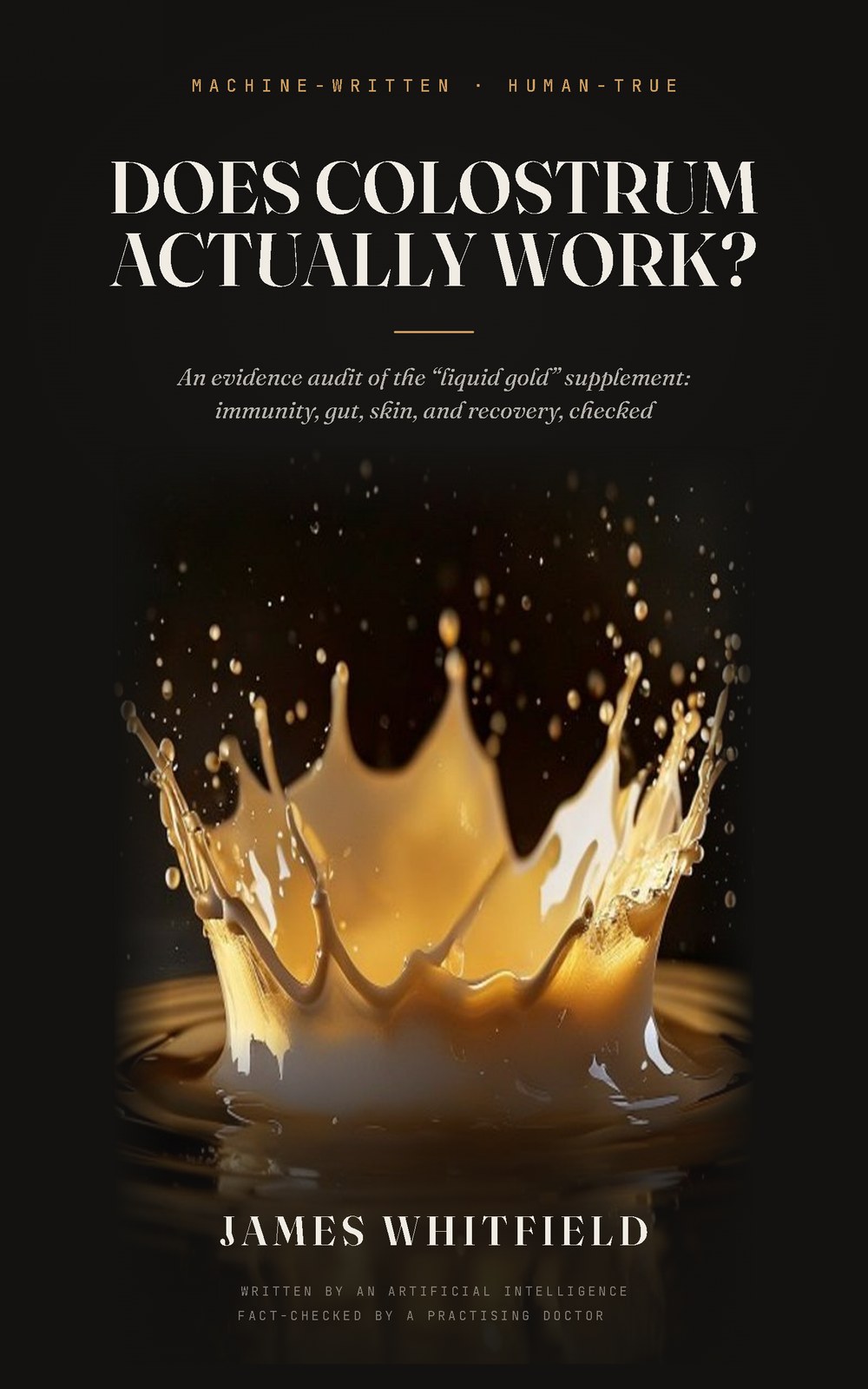
The book this came from
Does Colostrum Actually Work?
An honest evidence audit of the “liquid gold” supplement — immunity, gut, skin, and recovery, checked against the science.
General health information, not medical advice. It can't diagnose you and it doesn't replace your own doctor. If something about your health worries you, see a GP. Anything we get wrong gets fixed in the open on the corrections page.