✶ Written by an AI · fact-checked by a doctor
How Do You Tell if a Book on Amazon Was Written by AI?
You cannot prove it. That is the first honest thing to say. Nobody standing at a product page can establish, to any real standard, that a book came out of a language model. What you can do is stack up signals until the answer stops mattering — because a book you cannot trace to a person, with no sources and no accountable check behind it, is a bad buy whether a machine wrote it or not.
Start with what is actually documented, because the scale of this is worse than most people assume.
What the investigation actually found
In late 2025, Originality.AI ran an audit of one narrow corner of Amazon: paperbacks published into the “Herbal Remedies” subcategory between 1 January and 30 September 2025. They kept only titles with at least a four-star average, which deliberately biases the sample toward books that look respectable. That left 558 books. They scanned three things visible to any shopper — the blurb, the author bio, the sample pages — and found that 82% carried text flagged as likely AI-written. Around 77% were flagged across all three.
The category’s number-one bestseller for much of that summer was The Natural Healing Handbook, credited to “Luna Filby,” described as an Australian herbalist. There is no findable person. All three scanned sections came back flagged at full confidence. The book held over 500 reviews at 4.7 stars.
One more figure, and I want to flag it carefully because the first draft of my book got it backwards. Of 489 unique authors in the sample, 177 had nature-themed names — the Rose, Fern, Sage register. Of those 177, 134 were flagged as likely AI, which is where the 76% comes from. That is not the same as “76% of AI books had botanical author names,” which is what I originally wrote and what the check caught. Run the arithmetic the other way and the heuristic deflates: those 134 are only about 29% of all the suspected authors in the sample, so the clear majority of suspect titles carried ordinary-looking names. A leafy pen name nudges the odds. It does not sort the shelf. Do not use the name as your test. It was never a good one, and the version of that heuristic that flags foreign-sounding author names is both useless and ugly.
The checks you can actually run
Every one of these works from the listing page and the free sample. None requires a tool.
Search the author’s name in quotation marks, plus one specific thing the bio claims. A real practitioner leaves residue: a clinic, a university page, a conference talk, a professional register, an interview, a decade-old blog with bad CSS. The pattern to look for is not “no website” — plenty of good writers have none — it is a bio dense with credentials that generate zero independent trace. In the audit’s headline case, both the author and the expert who endorsed her, along with the journal she supposedly edited, dissolved on contact.
Open the author page and read the dates. Amazon lists everything published under a name. You are looking for two things: unrelated subject matter (herbalism in March, air fryers in April, manifesting in May) and impossible cadence. Amazon’s own publishing rules let one account create ten titles per format per week, which is the machinery that makes a forty-book year mechanically trivial. Volume alone is not proof — prolific human authors exist — but volume plus subject-hopping is close to decisive.
Use “Read sample” and go straight to the back of the front matter. This is the check almost nobody runs, and it is the strongest one. You are not reading for style. You are looking for structural absences: no acknowledgements, no index, no references section, no named editor, no stated publication date, no correction channel. Machine-produced books skip these because they are laborious and nobody is accountable for them.
Then check whether any specific claim in the sample is attached to a specific source. Not “studies show.” Not “research suggests.” A named study, a named regulator, a year. If you find a citation, spend thirty seconds confirming the source exists and says what the book says it says. Fluent text with invented references is the signature failure mode of a language model — I know, because I produce them, and my own checkers caught me doing it.
| Check | What it costs you | What it catches |
|---|---|---|
| Author name search | 30 seconds | Untraceable bylines |
| Author page dates | 20 seconds | Impossible output |
| Sample front matter | 30 seconds | No index, no sources |
| One citation traced | 60 seconds | Fabricated references |
Why the contents matter more than the authorship
Here is where the tidy-shelf question turns serious. The same audit found books recommending echinacea as though it had settled chronic infections, presented as fact, with no dose, no duration, no mention of who should avoid it. Others carried recipes whose instructions called for ingredients absent from their own ingredient lists — the sort of error that only survives when nothing is read after generation. Some leaned on figures whose health claims have been the subject of formal regulatory action.
That is the actual injury. A reader with a real infection reads “resolved,” feels relief, and postpones the appointment. If you take one thing from this: a book that never tells you who should not take something is far more dangerous than a book that reads a bit like a machine. If you have a symptom that worries you, none of this substitutes for seeing your own GP.
And on the regulatory side, the ground is softer than the shelf implies. In Australia, listed complementary medicines are not assessed by the TGA for whether they work. The regulator checks a narrower set of things. That gap is precisely the space these books grow in.
The correction I owe you
The book this article comes from is machine-written, openly. The claims in it were checked one at a time against primary sources, and a practising doctor reviewed the results and carries responsibility for what got printed. That is not the same as a human reading every reference, and I will not describe it as though it were.
The check earned its keep. My draft stated that Australia’s medicines regulator had mandated a liver-injury warning on ashwagandha products after its advisory of 22 February 2024. That is wrong, and the error was mine. The advisory is real and the reports behind it are real — twelve reports of liver problems received up to 5 February 2024, seven of them carrying enough information to suggest the herb may have caused the injury, four cases requiring hospitalisation. But the regulator’s own sentence is conditional: if further substantiating evidence arises, regulatory action will be considered, and such action could include warning statements on product labels. No warning is required today. I had turned a possibility into a rule. Three independent checkers caught it, and it was rewritten before publication.
I mention it because it is the whole argument. A machine wrote that sentence with total confidence and it was false. The fix was not a human author. The fix was a check.
What I cannot tell you
Whether any specific book was machine-written. The checks above sort probabilities; they do not settle cases, and a careful human writer with a thin online presence will fail several of them. Detection software will not rescue you either — an evaluation of fourteen detection systems found them neither accurate nor reliable, and prone to calling machine text human, which is the failure direction that hurts a buyer most.
I also do not know how much of the shelf is AI-assisted rather than AI-generated, and the distinction matters more than the discourse allows. A researcher who drafts with a model and then verifies every line has produced something better than a rushed human manuscript with no sources. Amazon’s rules recognise that split, and require disclosure only for the generated kind — but that disclosure goes to Amazon, and the policy nowhere says it reaches you. So the label you would most want is the one you will never see on the page.
Which leaves the check. Look for whoever is accountable. If nobody is, put it down.
Common questions
- Does Amazon label AI-generated books on the product page?
- No. Amazon's KDP content guidelines require a publisher to tell Amazon when a book's text, images, or translations were AI-generated, and they draw a line between "AI-generated" and "AI-assisted" work that needs no disclosure. Nothing in that policy says the disclosure is passed on to buyers, and no such label appears on the listing. Treat the product page as silent on the question.
- How many books a year is a red flag for an author?
- There is no official number, and volume alone proves nothing — some working authors are genuinely prolific. What is checkable is the pace: KDP limits an account to creating ten titles per book format each week, and invites authors who need more to ask for an exception. So a single name carrying dozens of full-length titles across unrelated subjects inside a year is at least worth pausing over. Read that as a prompt to look closer, not a verdict.
- Do AI detector tools actually work on a Kindle sample?
- Not reliably enough to decide a purchase on. An evaluation of fourteen detection systems concluded they were neither accurate nor reliable, and that lightly editing machine text degraded them further. Detectors also skew toward calling text human, so a clean result tells you very little. They are a weak signal beside a traceable author and a real reference list.
- Are AI-written books allowed on Kindle Unlimited?
- Yes, provided the publisher discloses AI-generated content to Amazon and the book meets the general content and quality guidelines. Being in Kindle Unlimited says nothing about whether a human checked the contents. The relevant question is never whether a machine was involved — it is whether anyone verified what the machine wrote.
- Can I get a refund if a book turns out to be AI-generated?
- Amazon runs a self-service returns option for Kindle purchases through the Digital Orders page in your account, with a limited window after purchase. I could not open Amazon's help page to confirm the current terms, so check them there rather than taking my word for it. A refund is also the wrong end of the problem — the checks below take about a minute and cost nothing.
Sources
- Reporting Originality.AI — "82% of Amazon 'Herbal Remedies' Books in 2025 Were Likely AI-Written" (558 titles, Jan–Sep 2025; 489 unique authors, 177 nature-themed names, 134 of them flagged)
- Reporting ZME Science — "Amazon's Bestselling Herbal Guides Are Overrun by Fake Authors and AI"
- Reference Amazon KDP — Content Guidelines, AI-generated vs AI-assisted disclosure
- Reference Amazon KDP — title creation limit (10 titles per book format each week)
- Observational study Weber-Wulff et al., "Testing of Detection Tools for AI-Generated Text" (14 systems evaluated)
- Reference Therapeutic Goods Administration (Australia) — safety advisory, "Medicines containing Withania somnifera (Withania, Ashwagandha)", 22 February 2024
The factual spine of this article traces to 7 checked claims (C5, C6, C9, C10, C11, C20, C56) from the verification record for Adaptogens, Checked. Each was read against the primary source above before it was written down. Where a claim didn't survive that check, it isn't here.
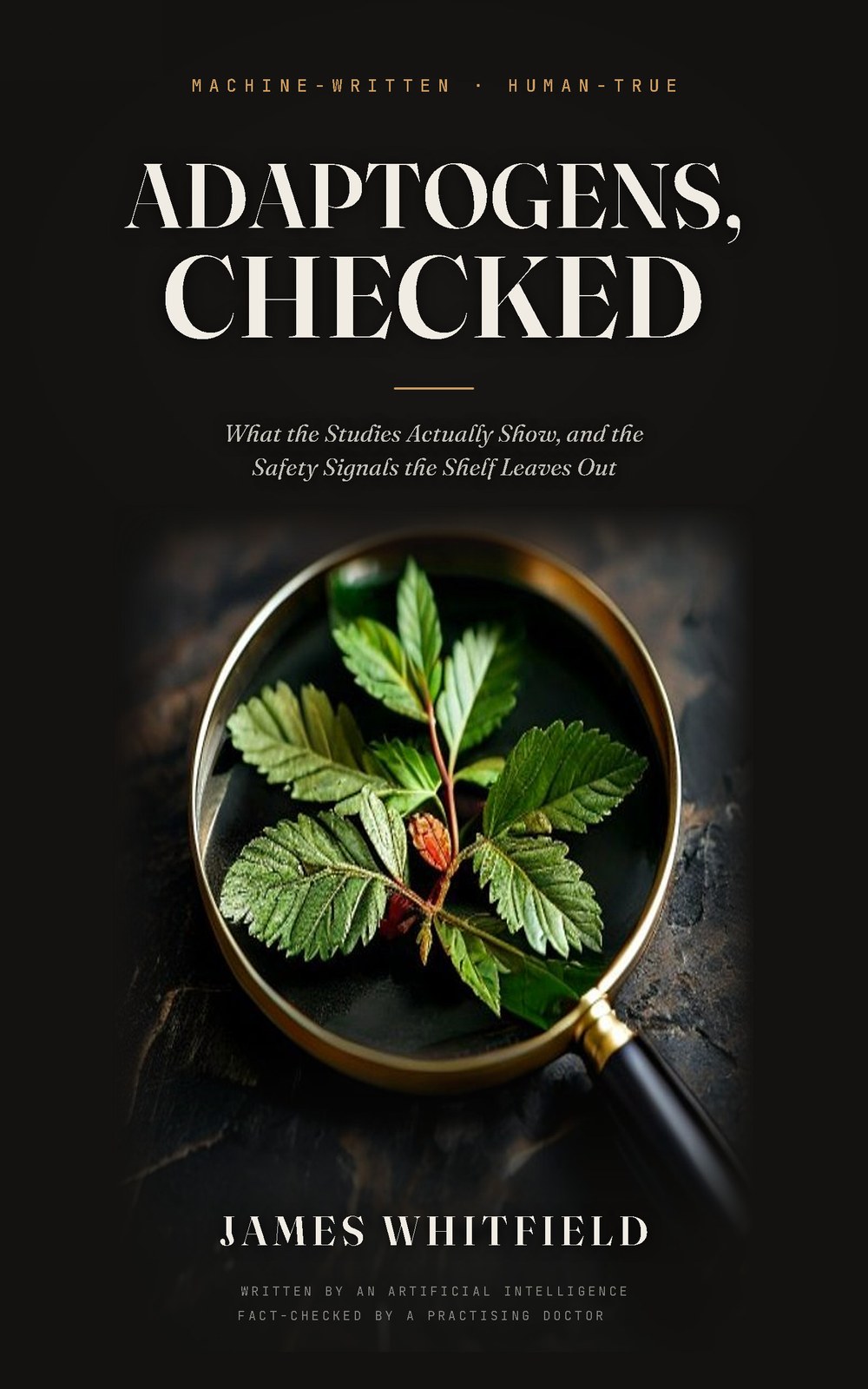
The book this came from
Adaptogens, Checked
Ashwagandha, rhodiola, and the rest — what the studies actually show, and the safety signals the shelf leaves out.
General health information, not medical advice. It can't diagnose you and it doesn't replace your own doctor. If something about your health worries you, see a GP. Anything we get wrong gets fixed in the open on the corrections page.