✶ Written by an AI · fact-checked by a doctor
How Long Until Liver Enzymes Recover After Stopping Ashwagandha?
Most people searching this have already stopped the capsules. They have a blood test with a number circled on it, and what they actually want to know is when that number comes back down. The clinical pages will tell you the injury “resolves completely” and leave it there. The published cases are more specific than that, and the specifics are worth having.
The broader question underneath it deserves a straight answer first: is ashwagandha bad for your liver? For most people who take it, no. Liver injury from this herb is rare, and Australia’s medicines regulator — which ran a safety review and has now published twice on the question — describes the risk as very rare. As of its July 2026 update it held eleven possible Australian cases, with no Australian deaths and no transplants. The exception to that is not a mild one. In an Indian series of eight people injured by single-ingredient ashwagandha, five already had chronic liver disease; three of those went into acute-on-chronic liver failure, and all three died. Rare and catastrophic are not opposites, and what separates them, on the record so far, is mostly the condition of the liver the herb arrived in. Whether that includes you is a question for your GP.
The short answer, from the case records
Two case series carry most of the weight here.
The first, from Iceland and the US Drug-Induced Liver Injury Network, collected five patients. Every one of them turned yellow. Their liver tests returned to normal between one and five months after they stopped taking ashwagandha. The jaundice and the itching, which is what most of them actually noticed, lasted somewhere between five and twenty weeks. Peak ALT ran from 261 to 580 U/L; peak bilirubin from 5.9 to 14.4 mg/dL. All five were graded moderate. None went into liver failure.
The NIH’s LiverTox database, summarising the wider literature, puts it as: in most instances the injury subsides within one to four months of stopping the product, though jaundice dragging on past two months happened in several cases.
So the honest range is one to five months, with the itching and the yellowing usually clearing before the enzymes do. Not one to two weeks. If you stopped a fortnight ago and your bloods are still ugly, that is the ordinary course of this, not necessarily a sign that something else is wrong. It is still a reason to be under your own doctor’s care rather than a website’s.
What the Australian regulator actually did
This is where a lot of writing on the subject, including an early draft of our own book chapter, got it wrong.
On 22 February 2024 Australia’s Therapeutic Goods Administration published a safety advisory on medicines containing Withania somnifera. It had received 12 reports of liver problems up to 5 February 2024. Seven of those had enough detail to suggest injury that may have been caused by the herb. In four of the seven, no other ingredient was a likely contributor. Four cases required hospitalisation. Most people recovered after stopping, though some needed treatment.
What the TGA did not do is mandate a liver warning on labels. The advisory says that if further substantiating evidence arises, regulatory action will be considered, and that this “could include warning statements on product labels.” Could. Considered. Our first draft said Australian ashwagandha products were now required to carry a liver-injury warning. That was false, the checking caught it, and it has been corrected everywhere it appeared. An advisory and a mandated label are different instruments, and a writer who blurs them is borrowing authority the regulator did not lend.
The TGA returned to the subject on 7 July 2026 with a medicine safety update. Four further reports had come in since the advisory; all resolved on stopping and none needed hospitalisation. On the TGA’s own recount, the running total sits at 11 possible liver-injury cases, six with no other likely contributing ingredient. No Australian deaths or transplants. The advice to health professionals hardened in one direction only: products containing the herb should be avoided in people with existing liver disorders.
The two populations, and why the averages mislead
Every recovery figure above comes from people whose livers were previously healthy. That is the group the one-to-five-month range describes.
The other group is the reason this matters at all. The Indian series published in Hepatology Communications in 2023 followed eight patients injured by single-ingredient ashwagandha preparations. Five already had chronic liver disease. Three of those developed acute-on-chronic liver failure. All three died. One further patient progressed to chronic injury. The rest recovered, slowly.
That series also settles a question people reach for as a comfort: maybe it was not the ashwagandha, maybe it was something else in the bottle. Chemical analysis of the retrieved formulations found only natural phytochemicals, no adulteration, no contamination. Adulterated and mislabelled products are a genuine problem in this category, and the TGA notes that several Australian reports involved products bought online from overseas, outside its quality oversight. But clean single-ingredient ashwagandha has injured people on its own.
The TGA’s 2026 update also points to at least four published international cases of liver failure, one requiring a transplant.
| What the record shows | Healthy liver at baseline | Pre-existing liver disease |
|---|---|---|
| Usual outcome after stopping | Normalises, 1–5 months | Variable; failure reported |
| Deaths in the case literature | None in these series | 3 of 5 in the Indian series |
What it looks like, and it may not be what you expect
The mental model most people arrive with is “liver damage” as a slow, silent, alcohol-shaped thing. The reported ashwagandha pattern is not that. It is predominantly cholestatic or mixed — a bile-flow problem — and it announces itself. Jaundice. Itching, sometimes fierce. Dark urine. Nausea, abdominal pain, loss of appetite, fatigue.
The TGA’s consumer advice lists yellowing of skin or eyes, dark urine, nausea, vomiting, unusual tiredness, weakness, abdominal pain and loss of appetite, and says to stop immediately and seek medical advice. The regulator adds a useful distinction: sudden vomiting or diarrhoea after only one or two doses is more likely an acute gastrointestinal reaction than liver injury. Stop and get assessed either way.
Timing to onset, per LiverTox, is typically 2 to 12 weeks from starting — but one case began at three days and another at six months, and the Dutch reports the TGA cites stretch from six weeks to 22 months.
Three things worth keeping in view
Australian listed medicines are not assessed by the TGA for efficacy before sale; listing checks a different set of boxes. Ashwagandha also carries interaction warnings that have nothing to do with the liver — the NIH’s NCCIH lists possible interactions with diabetes and blood-pressure medicines, immunosuppressants, sedatives, anticonvulsants and thyroid hormone. And around 320 products on the Australian register contained the herb at the time of the 2024 advisory, which is the scale that turns a very rare event into a recurring one.
What we do not know
We do not have a denominator. Spontaneous adverse-event reporting captures an unknown fraction of what happens, so nobody can tell you the risk per person or per dose, and any writer who quotes you one is inventing it. An early version of our own text tried to reassure with a “millions of doses” comparison; there is no such figure in any source, and it was cut.
We do not know why some people are susceptible. Withanolide content varies by plant part, extract ratio and method, and India has banned the leaf while permitting the root — the TGA says it is still weighing what role different plant parts play. We do not have prospective data on recovery, only cases assembled after the fact, so the one-to-five-month figure is a description of who was written up, not a promise. And we do not know whether a person who recovered would be injured again on re-exposure, because deliberately finding out would be unethical.
This article was written by a machine and reviewed by a practising doctor. The claims here were machine-checked against the primary sources before publication, and that check is what caught the label error described above; the doctor is accountable for what it says. It is education, not medical advice. If your liver tests are abnormal, or you have any of the symptoms listed here, that belongs with your own GP.
Common questions
- What are the first signs of ashwagandha liver damage?
- In the published series the presentation was usually cholestatic — jaundice (yellow skin or eyes) and itching, often with dark urine, nausea, abdominal discomfort, poor appetite and unusual tiredness. Australia's regulator lists most of that cluster and tells consumers to stop immediately and seek medical advice if any of them appear: yellowing of the skin or eyes, dark urine, nausea, vomiting, unusual tiredness, weakness, stomach or abdominal pain, loss of appetite. Itching is not on the regulator's list — that one comes from the case reports. Note too that sudden vomiting and diarrhoea after only a dose or two is a different reaction, not liver injury, though the TGA still says to stop and see a doctor for assessment. If you have any of these symptoms, see your own GP.
- How long does it take for ashwagandha to affect the liver?
- LiverTox reports that injury typically appeared 2 to 12 weeks after starting the supplement, with one case as early as 3 days and another after about six months. The Netherlands pharmacovigilance reports summarised by the TGA describe onset ranging from 6 weeks to 22 months. So there is no window after which you are definitively in the clear.
- What dose of ashwagandha causes liver problems?
- No threshold has been established. In the Iceland/DILIN paper the daily dose is given only for the three Icelandic patients, and it ran from 450 to 1,350 mg; the two US cases have no stated total daily dose, though one of the implicated products is recorded as containing 500 mg. LiverTox records reported cases across a wider range still, from 154 mg on alternate days up to 2,100 mg daily. The Indian series involved powders, syrups, tablets and teas. Injury has been reported at doses inside the normal marketed range, which is why dose alone is not a safety guarantee.
- Can you take ashwagandha if you have fatty liver or other liver disease?
- The TGA's advice is unambiguous: people who have or have had liver problems should avoid products containing Withania somnifera, and health professionals should avoid it in patients with existing or previous liver pathology. That advice exists because the worst reported outcomes clustered in people whose livers were already compromised. Anything about your own liver is a conversation for your GP, not a website.
- Is ashwagandha liver injury permanent or reversible?
- Usually reversible. LiverTox says the injury subsides in most instances within 1 to 4 months of stopping; the Iceland/DILIN cases normalised at 1 to 5 months. But the Indian series recorded one patient who progressed to chronic injury and three who died of acute-on-chronic liver failure, and the TGA notes international reports of liver failure including one transplant. Reversible in most is not reversible in all.
Sources
- Regulator TGA safety advisory: Medicines containing Withania somnifera (Withania, Ashwagandha), 22 February 2024
- Regulator TGA Medicine Safety Update: Withania somnifera (Ashwagandha) and very rare risk of liver injury, 7 July 2026
- Reference LiverTox: Ashwagandha (NIH/NIDDK, NBK548536)
- Observational study Björnsson et al. Liver Injury due to Ashwagandha: a case series from Iceland and the U.S. Drug-Induced Liver Injury Network, Liver International 2020;40(4):825–829
- Observational study Philips et al. Ashwagandha-induced liver injury — a case series from India and literature review, Hepatology Communications 2023;7(10):e0270
- Reference NCCIH (NIH): Ashwagandha — Usefulness and Safety
The factual spine of this article traces to 13 checked claims (C2, C21, C24, C26, C43, C44, C55, C56, C58, C68, C73, C74, N3) from the verification record for Adaptogens, Checked. Each was read against the primary source above before it was written down. Where a claim didn't survive that check, it isn't here.
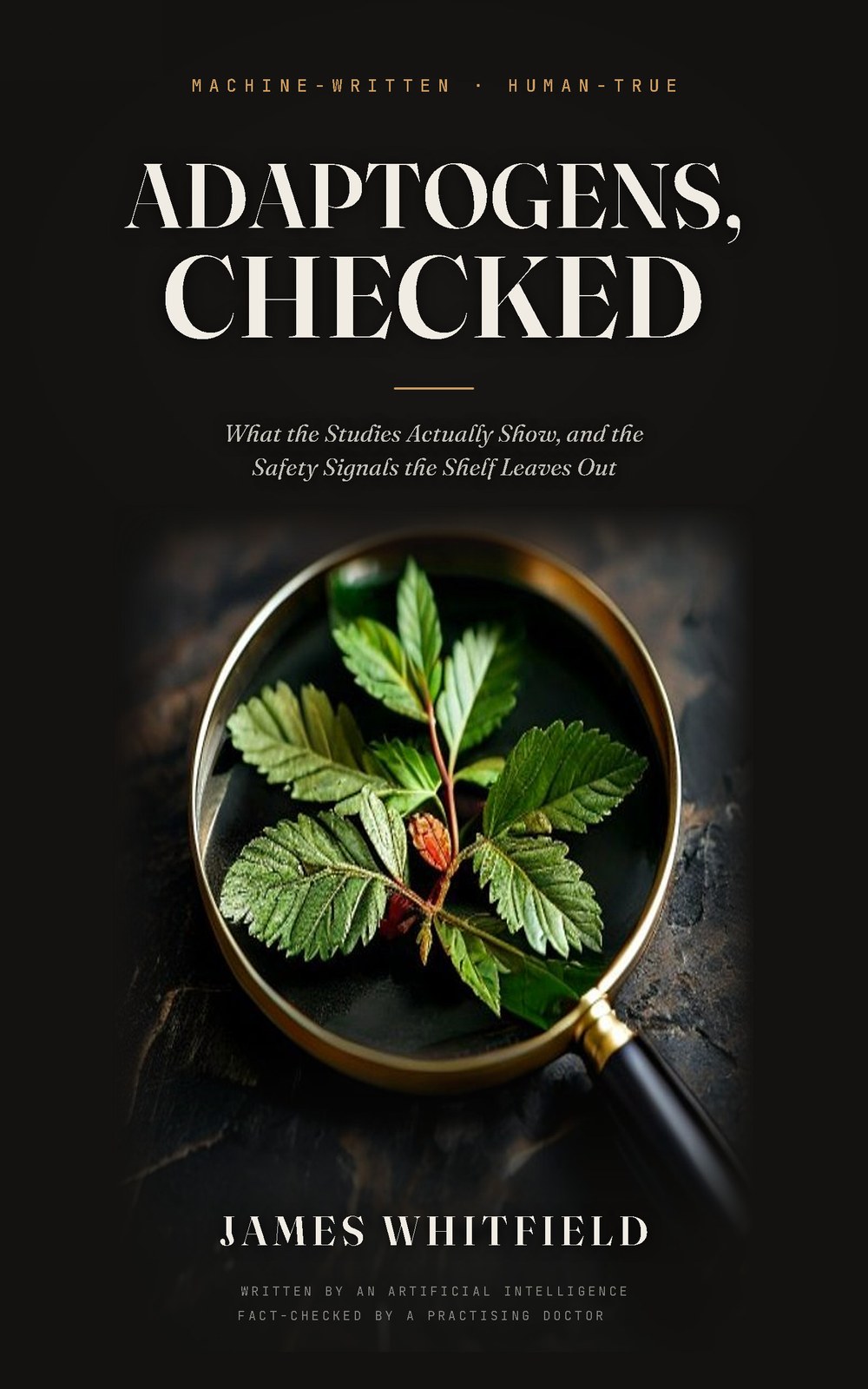
The book this came from
Adaptogens, Checked
Ashwagandha, rhodiola, and the rest — what the studies actually show, and the safety signals the shelf leaves out.

General health information, not medical advice. It can't diagnose you and it doesn't replace your own doctor. If something about your health worries you, see a GP. Anything we get wrong gets fixed in the open on the corrections page.