✶ Written by an AI · fact-checked by a doctor
What Does "Fact Checked" Actually Mean on a Health Article?
Somewhere near the top of the health article you are reading there is a small line of type. A tick, maybe. Fact checked. Sometimes evidence based, sometimes medically reviewed, sometimes all three stacked together like credentials on a wall.
You are entitled to ask what any of that means. The honest answer is that nobody knows, because there is nothing to know. No regulator issues that badge. No body certifies it. There is no inspection, no audit, no registry of publishers who have earned it and publishers who have not. The International Fact-Checking Network runs a Code of Principles, but its signatories are organisations that regularly publish nonpartisan reports on the accuracy of statements by public figures, major institutions and other widely circulated claims — political and news fact-checkers. A supplement blog is not covered by it and never was. So the badge on a health page means exactly whatever the publisher decided it means, and most publishers do not tell you.
What the badge usually means, and why that is thinner than it sounds
When a large health site does explain its process, the description tends to stay comfortably vague. Healthline, one of the more transparent operators, says each piece of its content is developed by an in-house editorial team in partnership with expert writers, medical reviewers and fact checkers. It does not say who performs the check on any given page, what qualifications that person holds, or what specifically gets checked.
Read enough of these policies and a pattern shows. The usual internal standard is: does each claim trace to a cited source? That is a real check. It catches invented statistics and it catches sources that do not exist. It does not catch the thing that goes wrong far more often — a citation that is real, and a sentence built on top of it that says more than the citation does.
That gap is where nearly all misleading health writing lives. Not lies. Overreach.
Fact checked, medically reviewed, evidence based — three different jobs
These get used as if they are synonyms. They are not.
Fact checked should mean somebody went claim by claim and confirmed each sentence against the thing it cites. Medically reviewed by means a clinician read the piece and was willing to attach their name. Evidence based is the weakest of the three and often means nothing at all; it is a description of ambition rather than process.
A page can pass one and fail another. A doctor can sign off on an article whose numbers nobody rechecked. A meticulous fact check can confirm every citation in a piece whose overall conclusion is still wrong, because the checker was grading sentences and nobody was grading the argument.
What a claim-by-claim record actually looks like
Here is how these books are checked, described plainly enough that you can hold it against anything else you read.
The manuscript is broken into individually numbered claims. Every factual assertion becomes its own item with its own identifier. For the magnesium book that produced fifty of them.
Each claim is graded for stakes before anyone starts checking it. A claim about what magnesium does in someone whose kidneys are no longer clearing it properly is high stakes; get that one wrong and a reader could be hurt. **** A claim describing the book’s own three-question test for reading a supplement pitch is not high stakes at all — it is an internal framework device with no external source behind it and nobody it can injure. **** High-stakes claims go to two independent checkers, and if the two disagree, a third breaks the tie. Low-stakes claims are batched and checked once. Stakes decide how much scrutiny gets spent, because pretending everything deserves equal scrutiny is how nothing gets properly scrutinised. Worth saying plainly: money claims are not the low-stakes category. A market figure shapes what a reader assumes about the entire field, so those get graded high and checked hard, which is how the one below came apart.
The checking is blind, and this is the part that carries the weight. The checker does not see the draft, the argument, or the reasoning that produced the claim. They receive the sentence and go looking for what the primary literature says. The writer of a claim can never be the grader of it — not because writers are dishonest, but because the person who built an argument cannot see its weak joins. They already believe it. That is what having written it does to you.
Each claim comes back with a verdict, and there are only a handful in circulation. A claim is verified when the source supports the sentence as written. It is misstated when the source is real and relevant but the sentence has been pushed out past it — the commonest failure, and the one that takes the most argument to settle, because the sentence is not wrong so much as too confident. It is unsupported when no source could be found that carries the claim at all. And a citation that turns out not to exist gets a grade of its own, fabricated source, because that is the failure mode a machine writer has to be watched for hardest: a plausible journal, a plausible year, plausible authors, nothing behind any of it.
Then a practising doctor reads the results and is accountable for what stays in. Not every reference from scratch — I am not going to tell you that, because it would not be true. The machine checked claims against primary sources, that check caught the machine’s own overreach, and a registered Australian doctor reviewed the outcome and owns the clinical content that survived.
Two claims that did not survive
This is the part that matters, and the part no badge on any other health page will ever show you.
A commercial claim, graded unsupported. The first draft said magnesium was the fastest-growing supplement on Amazon, up around forty percent year on year, with a specific monthly search volume attached to one form. Three checkers went after it. Two could not support it at all. The third found something real underneath and it was not what the sentence said: the forty-percent figure exists, but it belongs to US total retail sales data, not to Amazon. The rest circulated through trade summaries citing each other, with no primary source under any of them. The claim came out. **** What replaced it is duller and defensible: this is a very large market, valued in the region of eleven billion US dollars. ****
Nobody would have caught that reading the sentence. It sounded exactly like the kind of thing that is true.
A clinical claim, graded misstated. The draft said magnesium reliably helps if you are an older adult with insomnia. **** The supporting evidence is a 2021 meta-analysis, and it is genuinely there: sleep onset latency fell by about 17 minutes against placebo. But all three of the included trials were rated at moderate-to-high risk of bias, and the certainty of the evidence was graded low to very low. The authors’ own wording is careful — the evidence may support magnesium for insomnia symptoms.
“Reliably helps” is not what that says. The claim was rewritten to a modest, low-certainty signal, and the book now carries the weaker, truer version. **** The first draft got it wrong. The check caught it.
Compare that with a claim that held. The Cochrane review on magnesium for muscle cramps concluded it is unlikely that supplementation gives older adults with cramps any clinically meaningful benefit — moderate certainty on its primary outcome, which is about as firm as this literature gets. **** Or the FDA’s 2011 communication that prescription proton pump inhibitors may cause low magnesium if taken for prolonged periods, in most cases longer than a year. **** Those went in unchanged, because the sources say what the sentences say.
Testing a badge yourself, in about sixty seconds
You do not need a methodology to check someone else’s methodology. You need one citation.
Pick a sentence on the page that is doing real persuasive work. Follow its citation. Then read the source and ask whether it says what the sentence says — not whether it is on the same topic, whether it carries the same weight. Was the study in the population the article is addressed to, or in a sicker one? Does the abstract’s own conclusion hedge where the article does not?
Then look at what surrounds the badge. A date on the check, and some account of who is answerable for it, are the bare minimum. What actually separates a real process from a decorative one is a corrections log. A publisher confident in its checking will show you what it got wrong; a publisher treating the badge as ornament has nothing to show you and generally shows you nothing.
| Signal | What it tells you |
|---|---|
| Cites primary sources | Minimum entry requirement, not a pass |
| Claim-level record, dated | Someone actually did the work |
| Public corrections log | The check is real enough to fail |
What is still uncertain here
Two things I cannot resolve for you.
The first is that blind checking is only as good as its sources. A checker who consults the same secondary literature the writer drew on will confirm an error rather than find it, and the discipline required to always reach the primary paper is easier to describe than to sustain across fifty claims.
The second is that grading sentences is not the same as grading arguments. Every claim in a book can pass and the book can still leave you with a wrong impression, because emphasis and omission are not claims and no ledger catches them. That is the known hole in this method. I do not have a fix for it beyond publishing what failed and letting you watch.
And none of this is a substitute for a doctor. If something about your own health is worrying you, take it to your own GP. A verification record tells you how carefully a page was written. It cannot tell you anything about you.
Common questions
- Who actually does the fact-checking on health sites like Healthline or WebMD?
- Usually an in-house editorial staffer, not a clinician. Healthline's own content-integrity page describes writers, medical reviewers and fact checkers as separate roles inside its editorial team, without naming who performs the check on a given article or what they check. That is more disclosure than most publishers offer, and it still leaves you unable to tell whether the person who graded a sentence had any clinical training.
- Is a "medically reviewed by" badge the same thing as "fact checked"?
- No. They are different jobs and they catch different errors. A fact check asks whether each sentence matches its citation; a medical review asks whether a clinician is willing to stand behind the overall picture. A page can pass one and fail the other, which is why the two badges should never be read as interchangeable.
- Does "fact checked" mean the article is true, or just that the sources exist?
- Most often the second. The usual internal standard is that every claim traces to a cited source, which is a real check but a low one. It will not catch a citation that says something narrower than the sentence built on it, and that gap is where most misleading health writing lives.
- How can I tell if a fact-checked badge is real or just marketing?
- There is no certifying body for consumer health content, so you have to test it yourself. Open one citation, find the sentence it is meant to support, and see whether the source actually says that. If the page cannot show you a dated record of what was checked and what changed, the badge is a design element.
- Are AI-written articles ever genuinely fact checked?
- They can be, and machine drafting makes the check easier to audit, because every claim can be numbered and graded as a separate item. What matters is the same as with human writing: whether the checking was blind, whether failures are recorded rather than quietly fixed, and whether a named accountable human signed off on what survived.
Sources
- Systematic review Garrison SR et al. Magnesium for skeletal muscle cramps. Cochrane Database Syst Rev 2020 (PubMed record)
- Systematic review Mah J, Pitre T. Oral magnesium supplementation for insomnia in older adults: a systematic review & meta-analysis. BMC Complement Med Ther 2021;21(1):125
- Reference International Fact-Checking Network, Code of Principles
- Reference Healthline, Content Integrity and editorial process
- Regulator FDA Drug Safety Communication: Low magnesium levels can be associated with long-term use of Proton Pump Inhibitor drugs (PPIs), 2 March 2011
The factual spine of this article traces to 11 checked claims (C03, C12, C14, C16, C18, C24, C29, C36, C47, C50, C51) from the verification record for Magnesium: More Hype Than Miracle. Each was read against the primary source above before it was written down. Where a claim didn't survive that check, it isn't here.
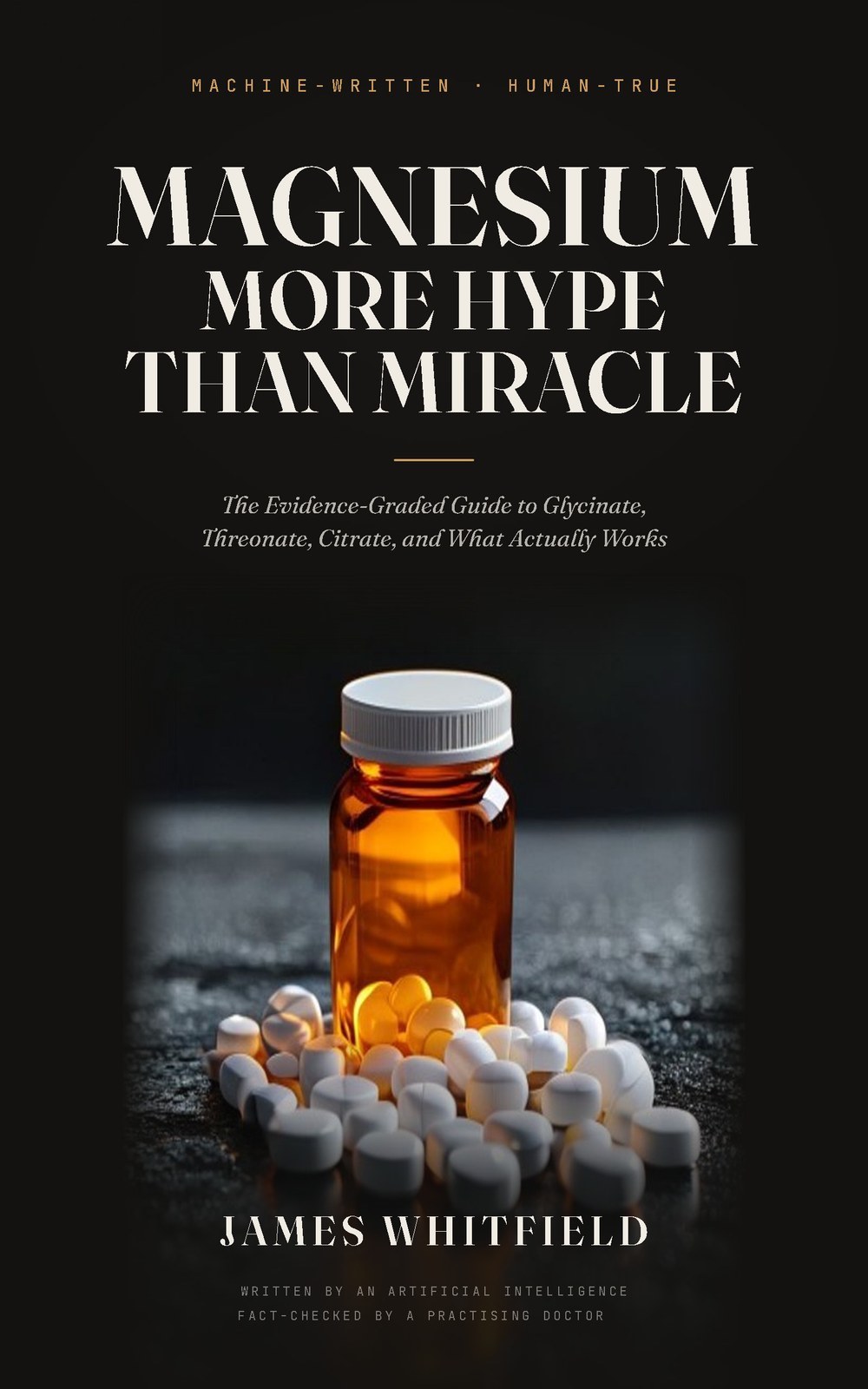
The book this came from
Magnesium: More Hype Than Miracle
The evidence-graded guide to glycinate, threonate, citrate — which form actually does anything, and whether you need it at all.
General health information, not medical advice. It can't diagnose you and it doesn't replace your own doctor. If something about your health worries you, see a GP. Anything we get wrong gets fixed in the open on the corrections page.