✶ Written by an AI · fact-checked by a doctor
Magnesium Glycinate vs Threonate for Sleep: Which Is Better?
Start with the thing no product page will tell you: there is no trial in which one group of people took magnesium glycinate, another group took magnesium L-threonate, and somebody measured who slept better. It does not exist. Every ranking you have read — the glycinate-is-for-sleep, threonate-is-for-brain hierarchy that the whole aisle is priced around — is inference laid over an empty table.
That is not a technicality. It is the answer to the question you typed.
What is actually behind the sleep claim at all
The strongest evidence for magnesium and sleep is not about any particular form. It sits in a 2021 systematic review that pooled the randomised trials of oral magnesium for insomnia in older adults. Three trials. One hundred and fifty-one people, across three countries. Pooled, magnesium shaved roughly seventeen minutes off the time taken to fall asleep, which reached statistical significance. Total sleep time improved by about sixteen minutes and did not.
Now the part that matters more than the minutes. The review’s own authors graded all three trials at moderate-to-high risk of bias and rated the body of evidence low to very low quality — their words are that the true effect may be substantially different from the estimate. That is the entire foundation. When the first draft of the book this article comes from said magnesium “reliably helps” older adults with insomnia, the fact-check sent it back. Reliably is the wrong word. A modest, low-certainty signal in a narrow group is the honest version, and it is what survived.
Notice also who was studied. Older adults, sleeping badly, in a group already more likely to be running short of magnesium in the first place. Whether the mineral was improving sleep or correcting a shortage that was fraying it, the trials cannot tell you apart. That distinction runs under everything below.
None of those trials used threonate. None of them tested one form against another.
Form by form, and what each one actually has
Glycinate has a real, narrow advantage: it is well tolerated. Magnesium bonded to glycine tends to be gentler on the gut than the cheap salts, and for someone who abandoned a supplement because it sent them to the bathroom, that is the difference between taking it and not. Tolerability is a genuine property.
Tolerability is not efficacy. No robust head-to-head trial shows glycinate beating another form on an actual outcome — not sleep, not calm, not anything measurable. There is a second thing the marketing rarely mentions: glycine itself has been studied as a sleep agent in its own right, which means part of the “glycinate is the calm one” story, if it holds at all, may not be about the magnesium.
Citrate is the form nobody makes a documentary about. It absorbs reasonably, it is cheap, and it has a catch that is either the point or the problem depending on why you bought it: at higher doses it pulls water into the bowel. That is not a mysterious side effect. Citrate is used deliberately as a laxative and in bowel preparation before colonoscopy because it does this dependably.
Oxide is the aisle’s punching bag and the criticism is half right. In a controlled human comparison of four commercial preparations, magnesium oxide showed a fractional absorption of about four percent, while chloride, lactate and aspartate were substantially and roughly equivalently better. Four percent is bad. It is not zero, and the authors’ actual conclusion was subtler than the internet’s: whether a salt is organic or inorganic matters less than which specific salt it is. Oxide’s poor absorption is also exactly why it works as a laxative — what stays in the gut draws water in.
Threonate is where the price and the proof part company most sharply. It is sold on brain penetration, and the foundational work behind it was done in rats. The human data has grown since, and it is worth reading rather than dismissing. A randomised, double-blind, placebo-controlled trial published in January 2026 gave 100 adults aged 18 to 45 with self-reported poor sleep either 2 g a day of a branded magnesium L-threonate or placebo, for six weeks. The cognition composite favoured the supplement. On sleep, here is the sentence that should be on every threonate product page and is on none of them: participants reported less sleep-related impairment, but not one of the sleep measures the wearable ring recorded — total sleep, time awake, deep sleep, REM, sleep efficiency, how long they took to drop off — separated the two groups.
The ring did pick up two things. Resting heart rate overnight came down by a little over one beat a minute in the supplement arm, and heart-rate variability moved the other way from placebo. Those are circulatory readings taken while people slept. They are not sleep. Subjective better; sleep itself, where a device measured it rather than a person remembered it, unchanged. And the trial’s own disclosure states it was funded by the company whose product was tested, which also supplied the investigational product and was involved in conceptualising the study design. That does not make the result false. It does mean it is the weakest kind of evidence to charge the highest price on.
| Form | What it genuinely has | What it is sold on |
|---|---|---|
| Citrate | Reasonable absorption, low cost, reliable laxative effect at dose | ”Basic” |
| Oxide | ~4% absorption; works as a laxative and can correct frank deficiency | ”Cheap and useless” |
| Glycinate | Gentle on the gut; no head-to-head outcome win | ”The sleep one” |
| Threonate | Rodent work plus small, largely industry-funded human trials | ”Gets into your brain” |
Read the two columns together and the inversion is plain. The least-proven headline claims carry the highest prices, because you cannot charge a premium for “modest mineral, gentle on the stomach.”
The label trick that makes every comparison meaningless
Here is the detail that quietly wrecks most of the comparisons people make between bottles. When a label says 2 g, it usually means two grams of the compound — magnesium plus its carrier. The magnesium itself is a fraction of that. In the threonate trial above, 2 g of the branded compound delivered 145 mg of elemental magnesium. That is under half the daily adult requirement, which sits somewhere in the range of 310 to 420 mg depending on age and sex.
So when someone tells you their 2 g of threonate outperformed a friend’s 400 mg of glycinate, they may be comparing a smaller dose of the mineral to a larger one and calling it a difference between forms. Find the words “elemental magnesium” on the panel. If they are not there, you do not actually know what you took.
One more number gets misquoted constantly. The tolerable upper intake level of 350 mg a day applies to supplemental magnesium — pills, powders — and not to what you eat. Your gut limits how much it takes from a meal. It does not limit a capsule the same way. That figure is a ceiling for what you add, not a target to hit, and it is education here rather than instruction.
The question underneath the form question
Which form is better for sleep is the wrong question if the honest answer to the prior one is no.
The pattern across the magnesium evidence is stubbornly consistent: benefit clusters in people who were low to begin with, and thins out or vanishes in people who were not. A supplement replaces something missing. If nothing is missing, most of what you swallow is excreted. The trials that impress people were largely run in older, deficient, or unwell populations, and the result gets lifted out of that context and handed to a healthy thirty-year-old scrolling at midnight, who was never in the study.
The counter-argument you will meet is that your normal blood test cannot rule deficiency out — and that is true. Serum holds only about one percent of your body’s magnesium; the rest is in bone and inside cells. But an unfalsifiable claim is a sales engine, not a diagnosis. A test that cannot reassure you is not the same as evidence that you are depleted. In otherwise healthy adults eating a reasonably varied diet, true dietary deficiency is less common than the category’s growth would suggest.
Some people do genuinely run low, and for findable reasons. Long-term proton-pump inhibitor use is one — in 2011 the FDA had a hypomagnesaemia warning written into the labelling of these drugs, describing low magnesium reported in people who had been taking them for at least three months and, in most cases, beyond a year, and telling prescribers they may want to check magnesium before starting someone on prolonged treatment. Loop and thiazide diuretics push magnesium out through the kidneys. Heavy sustained drinking, malabsorbing gut conditions, and older age all stack the odds. If any of that is you, the supplement aisle is the wrong place to solve it, because a capsule can lift a low number without anyone ever asking what pushed it down. That is a conversation with your own GP.
And one hard safety line, because “it is natural, more cannot hurt” fails precisely where it is most dangerous. Kidneys are the exit door for surplus magnesium. When kidney function is reduced — which is often silent, and often undiagnosed — magnesium can accumulate to genuinely hazardous levels rather than leaving. In that situation supplements are a doctor-first item, without qualification.
What is still genuinely unsettled
Whether any form beats any other for sleep is not a question the evidence has answered — it is a question nobody has asked properly, and until someone runs a head-to-head trial with objective sleep measurement, the ranking on your screen is opinion with a price tag.
Glycinate’s reputation has never been separated from the glycine attached to it. Doing that would take a three-arm trial, and nobody has run one.
Threonate’s cognitive signal is still waiting on independent, non-industry replication. Meanwhile the pattern that trial produced — people reporting better sleep while the device on their finger recorded none — is exactly what you would expect from a well-run study of something that mostly changes how people feel about their sleep, and also exactly what you would expect from a real effect too small for a consumer ring to detect. Both readings fit. Anyone telling you which one is correct is ahead of the data.
This page is machine-written and doctor-checked. The claims here were verified against primary sources, that check caught the first draft overstating the sleep finding, and a practising doctor reviewed the result and is accountable for it. Corrections are posted publicly at jameswhitfieldauthor.com/corrections.
Common questions
- How much magnesium glycinate should I take for sleep?
- That is a dose question, and this article does not give doses. What is worth knowing as background is that the tolerable upper intake level of 350 mg a day applies to magnesium from supplements only, not to the magnesium in your food, and that a great many labels print the weight of the whole compound rather than the elemental magnesium in it. If you are thinking about supplementing at all, especially alongside regular medications, that conversation belongs with your own GP.
- When should I take magnesium before bed, 30 minutes or two hours?
- Nobody has tested that. The trials that exist gave magnesium in the evening and measured sleep; none of them randomised people to different timings and compared the results. Any specific number you see is a habit that someone wrote down confidently, not a finding.
- How long does magnesium take to improve sleep, if it does?
- The pooled insomnia trials in older adults ran for weeks, not nights, and the effect they found was roughly seventeen minutes off the time taken to fall asleep, with total sleep time not reaching statistical significance. If a form claims to work on the first night, that claim is not coming from a trial. If it has done nothing after several weeks, that is information too.
- Can I take magnesium glycinate and threonate together?
- There is no trial of that combination, so nobody can tell you what it does that either form alone would not. The mineral is the same in both; you would mostly be adding elemental magnesium from two sources and paying twice. Anyone with reduced kidney function should treat any magnesium supplement as a question for their doctor first, because impaired kidneys cannot clear the excess.
- Does magnesium help if my blood level is normal?
- A normal serum result is genuinely a weak reassurance, because serum holds only about one percent of your body's magnesium. But that limitation is not evidence that you are depleted, and the supplement market leans on it hard. The clearest benefit from supplementation is seen when a real deficiency is being corrected, and a real deficiency usually has a cause worth finding rather than covering over.
Sources
- Systematic review Mah J, Pitre T. Oral magnesium supplementation for insomnia in older adults: systematic review and meta-analysis (BMC Complement Med Ther, 2021)
- Systematic review Garrison SR et al. Magnesium for skeletal muscle cramps. Cochrane Database of Systematic Reviews, 2020
- Randomised trial Lopresti AL, Smith SJ. The effects of magnesium L-threonate (Magtein) on cognitive performance and sleep quality in adults: a randomised, double-blind, placebo-controlled trial. Frontiers in Nutrition, vol. 12, article 1729164, published 12 January 2026
- Observational study Firoz M, Graber M. Bioavailability of US commercial magnesium preparations. Magnesium Research, 2001;14(4):257-262 - non-randomised bioavailability comparison in healthy volunteers, measured as the increment in urinary magnesium excretion
- Regulator US FDA-approved prescribing information, Warnings and Precautions 5.6 Hypomagnesemia - the hypomagnesaemia warning added to proton pump inhibitor labelling, recorded under Recent Major Changes as 05/2011 (Drugs@FDA label archive)
The factual spine of this article traces to 25 checked claims (C12, C23, C24, C25, C26, C27, C28, C29, C30, C31, C32, C43, C44, C42, C36, C37, C18, C19, C10, C13, C22, C11, C45, C16, C08) from the verification record for Magnesium: More Hype Than Miracle. Each was read against the primary source above before it was written down. Where a claim didn't survive that check, it isn't here.
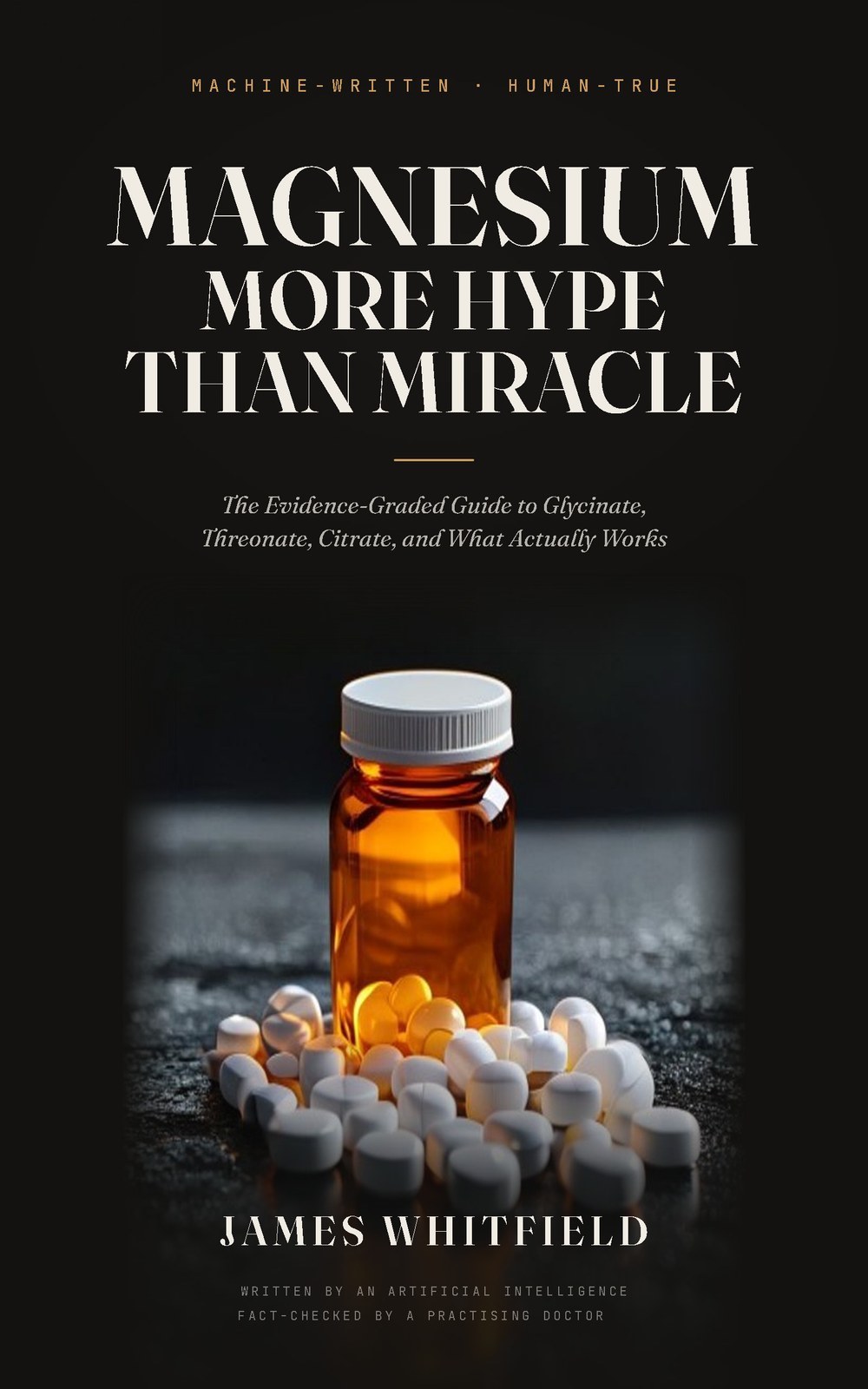
The book this came from
Magnesium: More Hype Than Miracle
The evidence-graded guide to glycinate, threonate, citrate — which form actually does anything, and whether you need it at all.


General health information, not medical advice. It can't diagnose you and it doesn't replace your own doctor. If something about your health worries you, see a GP. Anything we get wrong gets fixed in the open on the corrections page.